Clean power production in the Great North
Everyday wind energy grows and expands. Everybody wants in, witness Oklahoma's recent pitch in Europe, but only a few are going to be real players. Right now Texas and Minnesota/South Dakota appear to have to have a head start with two world leading efforts: T. Boone Pickins' giant planned West Texas wind farm - weighing in at 4,000 MW capacity, and the even bigger 5,050MW British Petroleum Titan project in South Dakota.
I had the opportunity to watch the development of a wind energy industry cluster in Minnesota first hand. Driving back and forth between Minneapolis-Saint Paul, where I lived for many years, and eastern South Dakota, where relatives lived, I saw the emergence of Lake Benton, Minnesota, as the "Original Wind Power Capital of the Midwest." (CNN did a story on Lake Benton and midwest wind energy efforts back in 2000.)
Starting with a few multi-story wind turbines on farmland in the 1990s, Lake Benton plans to have 200 such wind mills working when all is said and done. The area around Lake Benton, pop. 700, is called Buffalo Ridge and is mostly farmland. What makes wind energy popular among the locals, primarily farmers, is that by giving over a small fraction of their land to wind harvesting, they can generate about $2,000 per wind mill. (Sidenote: Interestingly, John Deere set up a wind power division recently.)
Lake Benton was one of the first areas in Minnesota to get wind energy fever. And big visions have emerged since. The North Star state wants to become a net exporter of wind-derived electricity by 2030. The state look to rally efforts to become the "Saudi Arabia" of wind energy. It even had a trade group called Energy Alley. (Energy Alley has since been aborbed into a larger initiative called the Minnesota Environmental Initiative.) The name of this group harkened back to Medical Alley, the association for Minnesota's most successful industry cluster--medical devices. (Medical Alley has since changed its name to LifeScience Alley, after merging with MNBio, the trades association for local biotech companies.)
Minnesota, primarily the Twin Cities, has one of the most developed industry clusters in the country, apart from Silicon Valley for information technology and New York for financial services, thanks to major players, like Medtronic, BostonScientific, St. Jude Medical, and Guidant. In fact, Michael Porter, strategy guru from Harvard University, used Minnesota's device cluster as an example when introducing the concept of industry clusters back in the late 1980s and early 1990s. Proponents of developing a renewable energy industry in Minnesota, therefore, had an excellent template to follow.
Although other regions of the country are better known for their connections to energy, primarily Houston, Texas, Minnesota does have some potential. In addition to wind energy in places like Lake Benton, the state's economy is strongly tied to agriculture, especially corn and soy beans. (It's no coincidence that agribusiness giant Cargill, one of the largest privately owned companies in the world is based in a Minneapolis suburb.)
Corn is useful for providing biomass-based fuels like ethanol, another renewable energy source. Before the recent financial meltdown, over in Western Minnesota and Eastern South Dakota, about an hour from Lake Benton, extensive development was taking place in the ethanol fuel industry via companies like VeraSun Energy and Fagen Inc. Also thanks to a joint venture between Cargill and Dow, biotechnology is being used to create plastic out of corn. (Aside: I own a corn-based plastic blanket, and it works just fine.)
Another reason renewable energy may succeed in Minnesota, a primarily democrat state, is that politically speaking everybody can get behind clean/green energy. Along those lines, the University of Minnesota has launched the Initiative for Renewable Energy and the Environment (IREE) to coordinate research efforts into alternative energy technology. (BTW, I don't know if the allusion to Bob Marley is intentional here, but we are talking about a bunch of university students.)
Minnesota is hoping that with wind, ethanol, and, possibly, hydrogen technologies, the next big thing for the state, could be the energy that will power America in the future. [P.S. The Economist recently annointed North Dakota (Minnesota's and South Dakota's neighbor) with the appellation of "energy producer."] .:.
TexasTriangle Twitter Feed
Tuesday
Tilting at Wind Energy
Monday
Brights Lights, Big Cities
Light pollution and earthbound constellations
Growing up in northern San Diego county, I had the unique opportunity to be only 30 minutes from the Pacific Ocean and 60 minutes from Mt. Palomar. For my money, I preferred treks up the 5,600 foot peak more than to the beach. One reason was the Mt. Palomar Observatory, which was once the largest telescope in the world and is still used today to track down objects in outer space. Proximity to the Palomar Observatory was good for me, it was bad for astronomers. Widespread light pollution from nearby growing cities in San Diego county reduced the ability of Palomar to capture as crisp as pictures as it might have otherwise. It's a problem facing telescopes all over the world.
Although that stray city light obfuscates views of the heavens, it has proved useful in illuminating (no pun intended) things down here on Earth. Just as starlight is a telltale of the powerful thermonuclear engines at work inside stellar bodies, so Earth-observing scientists at NASA found that shining lights from Earth gives clues about the engines driving the world's economy. They found that city lights very good indicators of urbanization.
We're not talking about population, mind you. China and India combined have ten times the number of citizens as the U.S., but those countries are far dimmer at night thanks to fewer modern, electrified cities. When analyzing what I'll call "ground constellations" across the U.S., the scientists found great concentrations of light.
The brightest groupings came from those (pesky) cities that leave their lights on all night long. And it became quite evident that cities formed clusters that didn't fit neatly into city, county, state or national boundaries. The U.S. Census has no official term to describe large urban complexes beyond combined statistical areas, consisting of metropolitan areas that are economically interlinked, and, consequently, no way of measuring them. Clearly there was something that needed measurement, however.
These mega cities were not limited to just the U.S. There appeared to be as many as 20 supersized metropoli across the face of the planet. Obeservers of census data also were discovering evidence for such uber-urban areas. Robert Lang, a professor at the Metropolitan Institute at Virginia Tech, explains that as far back as the 1960s, Jean Gottman pointed out the existance of a "megapolitan" centered on New York City and surrounding metros in the Northeast. Although distinct cities, they could also be thought of as a single mega city.
Lang decided to use the same term to describe the supercities he discovered through his own research, which he encountered working through Census data from the ground up. He initially discussed 10 megapolitans in the U.S., but has since refined his list to 20. He's even written a book on the subject, due out the summer of 2007. Alternatively, the America 2050 initiative has adopted its own criteria to describe America's megas, based on the Regional Planning Association's (RPA) defintions. It has ten, very similar to, if not the same as, Lang's original list. The two systems are now pretty much integrated, with Lang's 20 megapolitans forming the constituents of the RPA's 10 mega regions.
The lone exception may be that the RPA includes Minneapolis-Saint Paul as part of the Great Lakes mega region, and Lang does not. Having lived in the Twin Cities for many years, I believe that they do indeed belong to a Great Lakes mega. Chicago represents the hub of the Midwest. In fact, the state of Minnesota's Department of Transportation studied air cargo transport (important for high-value manufacturers such as the medical device makers that dominate the Twin Cities business landscape). They found that 90% of air cargo in the region is shipped to Chicago's O'Hare Airport, rather than from MSP International.
This concept of megapolitans and mega regions is taking off. There's an increasing number of organizations looking into "megas" to see how to leverage them to enhance the economic productivity and performance of local areas. .:.
Posted by editor at 23.3.09 0 comments
Wednesday
Not So Sunny Solar Power Forecast
National solar power study forecasts meager growth in Texas
In the last decade or so, energy has gone from being a ho-hum industry where nothing ever changes to being front page news - outside of Texas. Not since the anti-nuclear movement of the 1980s has the energy stirred such emotions - outside of Texas. Within Texas, of course, energy has been front and center for more than a century (Spindletop's oil was discovered January 10, 1901).
Energy's bandwagon fans are hard at work these days trying to make the economic case for any and all sorts of energy feed stocks, except oil and gas.
The latest study comes from the Solar Energy Research & Education Foundation (SEREF), a 501(c)(3) run by the Solar Energy Industries Association, that commissioned an 8-year study to look into solar energy's impact on the economy. The big conclusions:
...[T]he solar industry will create 440,000 permanent jobs, and capture more than $230 billion in new investment by 2016 with passage of an 8-year solar investment tax credit (ITC) by Congress. The report also found that an 8-year extension of the ITC would triple solar energy production from 9,000 to 28,000 gigawatts by 2016.Texas' share of this bonanza... 0.227%. Yes, that decimal is in the right place. According to the report, other states will do far better, e.g., Florida should add 22,000 jobs and New Jersey 10,000.
The foundation does provide some pretty nifty visuals, including a U.S. solar jobs map in Google Earth (requires download of a free Google Earth viewer) and state-by-state analyses of potential job creation. Texas' fact sheet can be downloaded from here as a PDF, and includes 17 manufacturers, 128 installers and project developers, and 7 organizations. .:.
Posted by editor at 11.3.09 0 comments
Labels: cleantech, clusters, energy, ExoTex, Texas Triangle
Sunday
Innovation Clusters - UPDATED
Non-Energy Clusters
- Austin Technology Incubator
- Biotech Initiative
- Houston Technology Center
- IC2 Institute [Austin]
- Metroplex Technology Business Council
- Music Industry [Statewide, Portal]
- Nanotechnology Initiative [Statewide, Portal]
- New Media Consortium [Austin, Portal]
- Rural Alliance for Renewable Energy (RARE)
- Social Media Club [Austin]
- Telecom Corridor [Richardson; Portal]
Clean Tech & Energy
- National Algae Association
- Energy Corridor [Houston]
- SEED Coalition (Sustainable Energy and Economic Development)
- Solar San Antonio (SSA)
- Solar Energy Society (TXSES)
- Solar Energy [Austin, Portal]
- Renewable Energy, Texas Land Office [portal]
- Renewable Energy Industry Association [TX; Portal]
- Renewable Energy Association of Central Texas (REACT)
- Metropolitan Partnership for Energy [San Antonio]
- Infinite Power of Texas [renewables]
- Houston Renewable Energy Group
- El Paso Solar Energy Association (EPSEA)
- Clean Energy Incubator [Austin]
- Alternative Energy Institute
Industry Studies
- Aerospace & Defense [TX; PDF]
- Automotive Manufacturing [TX; PDF]
- Aviation & Aerospace [TX; PDF]
- Biotechnology [TX; PDF]
- Energy Production [Energy Information Agency]
- Energy Report [comprehensive; TX Comptroller; 2008]
- Nanotechnology [TX; PDF]
- Renewable Energy [Energy Conservation Office; 2008]
- Semiconductors [TX; PDF]
Information Infrastructure
- Media - All Cities, All Media
- Media - Statewide
- Power - Daily Wholesale Market Data [2004-]
- Power - Market Directories [multiple lists]
- Power - State of the Market Reports
- Telecom - Area Codes [map]
- Telecom - Cable Providers [list]
- Telecom - Competitive LECs [list]
- Telecom - Incumbenet LECs [list]
- Telecom - Long Distance Carriers [list]
- Telecom - Municipal Providers
- Telecom - Payphone Providers [list]
Transportation Infrastructure
- Texas Railroads [AAR.org]
- National Bridge Inventory [FHWA.dot.gov]
- Ports Directory [TexasPorts.org]
- 2008 Texas Transportation Report [BTS.gov]
- Texas Energy Production Report [EIA.gov]
- Texas Ports - map [WorldPortSource.com]
Regional Focus
- Atlanta [Council on Competitiveness, report]
- Biobusiness Alliance [Minnesota]
- Cambridge Investment Research [Cambridge, England]
- Great North Alliance [Minneapolis-St. Paul]
- Indiana Business Research Center [Kelley School of Business; good comparative data v. other states]
- MBBNet [Minnesota, biomedical portal]
- Minneapolis-St. Paul [biotech & biomedical]
- Pittsburgh [Council on Competitiveness, report]
- Research Triangle [Council on Competitiveness, report]
- San Diego [Council on Competitiveness, report]
- Wichita [Council on Competitiveness, report]
- World Financial Centers, Top 50 [PDF]
- Demography of Clusters [overview of cluster iniatives, PDF]
- Clusters of Innovation Initiative: Regional Foundations of U.S. Competitiveness [Council on Competitiveness, report]
- Clusters of Innovation Initiative [multiple MSAs]
- U.S. Clusters [4MB+ PDF]
- The Cluster Initiative Greenbook [how-to, 2MB PDF, free registration req.]
- Harvard Clusters Database [833 worldwide clusters, PDF]
- America 2050 Project [megas, national]
- Brookings Institution [business location]
- Council on Competitivness [international, regional and local]
- Cyberstates [clusters, high technology]
- Harvard Institute for Strategy and Competitiveness [industry clusters]
- Metropolitan Institute at Virginia Tech [megas, national & international]
- Milken Institute [regional economics]
- The Citistates Group [regional biz thinktank]
Megapolitan Case Studies & Reports-Updated
- The Texas Triangle as Megalopolis [Houston Business]
- The Simple Economics of the Texas Triangle [Houston Business; PDF]
- Texas Urban Triangle [Texas A&M; 35MB, 150pg PDF]
- Opportunity Urbanism [Houston] (43pg PDF)
- Megaregions: Literature Review of the Implications for U.S. Infrastructure Investment and Transportation Planning [FHWA.dot.gov]
- Economic Progress in the Texas Economy [Houston Business, PDF]
- Economic Development Opportunities For U.S. Mega-Regions
- Connecting the Texas Triangle [whitepaper; RPA.org]
- Beyond the Metroplex [Dallas-Fort Worth]
- Austin-San Antonio Metroplex
- America 2050: Texas Triangle
- Beyond Megalopolis [U.S. megapolitan areas, PDF]
- Bright Lights, Big City [NASA study of urbanization]
- Cascadian Ecopolis [Portland-Seattle-Vancouver, 2MB+ PDF]
- Do Regional Economies Need Regional Coordination? (Edward Glaser) [3MB+ PDF]
- Megalopolis Unbound [Northeast, 8MB+ PDF]
- Nor Cal - California's mega of the north
- Opportunity Urbanism (Houston) by Joel Kotkin [43pg PDF]
- The New Megalopolis (Newseek.com) [good overview]
- Third California by Joel Kotkin [20pg PDF]
Texas
United States
Posted by editor at 1.3.09 0 comments
Labels: economy, ExoTex, megaregional, megas, metros, reports, urban ecology
Thursday
X-Raying Silicon Valley's Guts
Clusters of clusters form fabric of tech Mecca
Excellent article in NY Times by Steve Lohr examining the inhomogeneity of Silicon Valley's technology clusters.
Silicon Valley, the wellspring of the digital technologies fueling globalization, is itself a collection of remarkably local clusters based on industry niches, skills, school ties, traffic patterns, ethnic groups and even weekend sports teams.
“Here, we have microclimates for wines and microclimates for companies,” said John F. Shoch, a longtime venture capitalist.
Silicon Valley, home of Stanford and other universities, has long been the model of success for a modern regional economy, and policy makers worldwide have tried to emulate it by nurturing high-tech companies around universities. There have been a few winners, like the semiconductor manufacturing hub in and around Hsinchu Science Park in Taiwan.
Yet a look at the microclusters within Silicon Valley demonstrates the business relationships, the social connections and the seamless communication that animate the region’s economy. It also suggests the human nuance behind the Valley’s success and shows why that success is not easy to copy, export or outsource.
“These microclusters turn out to be a very efficient way to innovate, to see what works and what fails, and do it extremely rapidly,” said AnnaLee Saxenian, an expert in regional economies and a professor at the University of California, Berkeley."
The articles says, a start up will located depending on its segment of the information technology industry:
New companies, and emerging industry clusters, seek to build on and tap the skills of older clusters. While there are plenty of exceptions, it is generally true that hardware clusters — semiconductors, disk drives and network equipment, for example — are in the South Valley, around San Jose and Santa Clara. The actual manufacturing of hardware, of course, moved to cheaper places years ago. What remains in the Valley is product design and engineering.
Moving farther north in the Valley typically means moving farther away from the guts of the machine and climbing up the tiers of computing — from chips to layers of business and consumer software and then into San Francisco, home to people with online advertising and digital design skills.
For start-ups, the location decision can be critical, particularly because of the area’s notorious traffic jams. Lately the calculations about traffic, talent and real estate have become trickier because the Valley’s economy is surging again, driving up rents and salaries and clogging roads.
But there are other drivers for the clusters: social connections between Standford alumni or ethnicity.
New companies with deep ethnic links — mainly Indian and Chinese — are sprouting up in the Valley. Often, ethnic background is but one layer of social relationship. SnapTell, a start-up that seeks to marry image-recognition technology, cellphones and marketing, was founded last year by G. D. Ramkumar and Gautam Bhargava, Indian computer scientists and Valley veterans. The company has 10 employees, six of whom have Ph.D.’s and three of whom are from Stanford.
The shared backgrounds, interests and schools make for frictionless communication that fosters rapid innovation.
Even weekend sports, it seems, become the basis for informal business clusters in the Valley. Start-up ideas or job opportunities often surface on the sidelines of a weekend soccer game or, increasingly, cricket match. Giriraj Vengurlekar, an engineer who lives in Sunnyvale, plays in one of the Valley’s cricket leagues, which now has 40 teams. His team, the Centurions, includes employees of Sun Microsystems, eBay, Cisco, Yahoo and other technology companies.
Last year, Mr. Vengurlekar joined Serus, a start-up that makes software for managing offshore manufacturing operations. The cricket pitch, he finds, is a good place to scout recruits or learn of job openings. “People don’t play cricket to get jobs, but it definitely happens,” he said. “Cricket definitely spills over into business.”
Finally, Silicon Valley is monolithically geeky.
There is a certain visual identity to the clusters, and a hint of cultural tension among them. The clearest schism, perhaps, separates Valley dwellers from San Francisco residents.
The hard core in the Valley jokes that San Francisco, with its Internet advertising and design cluster, has a “high P.I.B. coefficient,” for People in Black. The city’s companies also have more women than those in the Valley. San Franciscans regard Valley engineers as denizens of a style-free suburban zone for whom being well-dressed means wearing jeans and a T-shirt with a company logo.
As Marc Adreessen, co-fonder of Netscpae, and two other Valley start-ups observes:
“The nerds with minimal social lives like me are well down in the Valley, and the cool kids with the trendy glasses and Prada shoes who like to go to parties are in San Francisco,” Mr. Andreessen said in an e-mail message. “You can guess who has the leg up in building companies.”GEO
Posted by editor at 20.12.07 0 comments
Labels: clusters, ExoTex, metros, Silicon Valley, technology
Sunday
Emergence of Transnational City States
New York and London new form of city
A recent Financial Times article argues New York and London have emerged as a unique global city state that transcends national boundaries. GEO
Posted by editor at 9.12.07 0 comments
Labels: economy, ExoTex, London, megas, metros, New York, NyLon, urban ecology
Mega Watching
Creative Class proponent releases study of mega regions
Richard Florida who argues that cities should work to retain their "creative class" as a key to economic prosperity has released a new report looking at the world's 40 largest mega-regions, in the U.S., Europe, Middle East, and Asia. The report ranks the regions and includes interesting qualitative data as the number of patents issued to the region. GEO
Posted by editor at 9.12.07 0 comments
Labels: economy, ExoTex, megas, metros, urban ecology
Friday
Money Centers
What cities will dominate tomorrow's global finance industries?
A recent special report, "Magnets for money," by The Economist runs a series of fascinating articles examining the global financial services industry. Today New York and London are the big dogs, but other cities, like Hong Kong and Singapore, show promise.
Draws heavily on City of London's "The Globabl Financial Centres Index," which in turn draws on a study by the City of New York, "Sustaining New York's and the US' Global Financial Services Leadership." GEO
The New New Math
Fuzzy wuzzy was just an idear,
Fuzzy wuzzy was worth $1 million squared.
Fuzzy wuzzy's buyer wasn't very good with math was he.
The New York Times reports on the vertigo-inducing valuations Silicon Valley companies are receiving lately. Money quote from Right Media’s chief technology officer, Brian O’Kelley, who became a millionaire after Yahoo! acquired his company for $850 million: “I have to say I giggled. There is no way we quadrupled the value of the company in six months.” GEO
Posted by editor at 19.10.07 0 comments
Labels: clusters, entrepreneurs, ExoTex, metros, venture capital
Tuesday
Knife Fight
New tax has beverly Hills' cosmetic surgeons up in arms
For decades, Beverly Hills' 2,400 doctors have taken advantage of a much lower tax rate than other commercial enterprises. That economic incentive along with access to a rich, image-obsessed clientele has given rise to a cosmetic surgery cluster, the Wall Street Journal reports. Now the city wants to significantly raise its tax rates for doctors, but the surgeons are fighting back using both sticks and carrots. While threatening lawsuits and mass exoduses, they're arguing they are an economic net good because they attract wealthy individuals from around the world to Beverly Hills for surgery. The city is sclaing back its plans, and hopes to reach a compromise by the end of the year. GEO
Posted by editor at 9.10.07 0 comments
Paris Gets Serious
France loosens reigns, tries to stay competitive
With London and New York City the top two updisputed financial centers of the world, Parisians are making changes to keep up, reports The Internation Herald Tribune. The French are looking for ways to reduce the regulatory burden of doing business in France, including permitting financial information to be submitted only in English. Pressure on the French is substantial. A new study, sponsored by the City of London, ranks the top 50 world financial centers. Paris comes in at only #11, just better than Toronto and not as good as Geneva, meaning plenty of work will need to be done. GEO
Magnate Magnet
London excels at drawing super rich
Yet another reason London is emerging as the world's financial center is its ability to attract the most well-heeled indviduals on the planet. The Wall Street Journal reports that London is experiencing a boom in billionaires, and that they aren't home-grown. From Iceland to India, the gigawealthy are settling down in London. The paper reports that of the 10 richest individuals in the U.K., only three are originally from there. They are being drawn by low taxes, and ease of conducting business around the world. GEO
Desperately Seeking Creatives
New empirical study looks for Europe's "creative class"
The JENA Economic Research Papers group released a paper that tries to identify where Europe's creatives reside, and what impact they have on the economy. The study seeks to put numbers to Richard Florida's book, The Rise of the Creative Class, which argues that the so-called creative class is important to urban and economic development. Lures for such creatives include cultural and social institutions, and a diverse environment open to potentially hedonistic ideas. Florida argues strongly against social capital thinkers like Robert Putnam in Bowling Alone. His hypotheses are not without critics, which includes Joel Kotkin, author of The City. GEO
Posted by editor at 2.10.07 0 comments
Labels: clusters, EU, ExoTex, urban ecology
Thursday
High Speed Rail Booms
Airlines' loss is Amtrak's gain
Just this year, the number of commuters using Amtrak has grown by 6%. The Wall Street Journal reports that the biggest surge in ridership since the 1970s. For the high speed Acela line running between New York and Washington, D.C., ridership is up 20% in just 10 months. The paper attributes the rise to increasing delays and security hassles with flying, making trains a good option for the estimated 10,000 daily train and plane commuters traveling between New York City to D.C.
Accompanying the article is an interview with Amtrak's CEO Alex Kummant. GEO
Posted by editor at 23.8.07 0 comments
Labels: ExoTex, metros, Northeast, transportation
Wednesday
The Great Warm North
When 7,000 airline passengers were grounded for a week in Newfoundland, Canada, because of 9-11, something amazing happened, reports the Wall Street Journal on August 8, 2007 . Many enjoyed their unplay stay so much, they kept coming back. They discovered a scenic coast line complete with icebergs and humpback whales, and an average temperature that has risen 4 degrees in the last 20 years. Seaside cottages cost only about as much as an SUV, reports the newspaper, and some areas are becoming tourist, and real estate, hot spots, such as Twillingate.
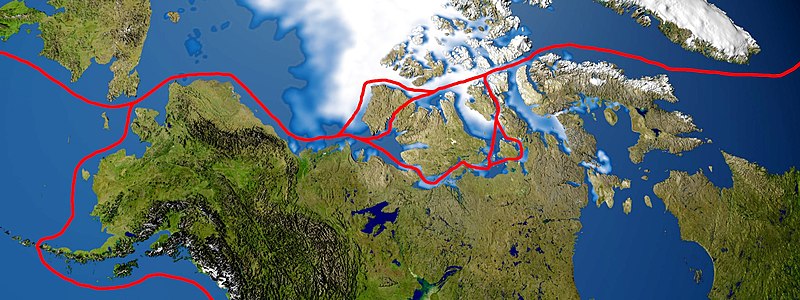
There is also the promise of untapped oil resources, which is causing friction between northern countries. The AP reports that Russia is working to create a legal case for their claim to millions of square kilometers of territory under the Arctic Ocean. International law says that a country can claim rights to seabed within 200 miles of its continental shelf. And new research is showing that Russia's territory may extend farther beneath the sea than previously thought. In early August, Russia even went so far as to recreate an inner space version of the Moon landing by sending a sub to the bottom of the Arctic to drop a titanium Russian flag, symbolically claiming the territory. The prize is a possible 10 billion tons of oil and gas deposits. GEO
Posted by editor at 8.8.07 0 comments
Labels: Canada, climatechange, clusters, ExoTex
Thursday
Middle Eastern Boom
Economic expansion taking place in former "economic backwaters"
Although explosions are what one thinks in terms of the Middle East and North Africa (MENA), the region is seeing an economic expansion that is giving new vitality to the region, The Wall Street Journal reported on July 19.
Inflows of foreign direction investment in MENA has quadrupled over the past six years from less than $5 billion to nearly $20 billion. That number doubles when including Turkey, a Muslim country that straddles the divide between Middle East and Europe. (Isreal is counted separately, but it too is experiencing rapid growth.)
Overall the economies in that region are growing at more than 5% a year, which beats most developed countries (though not as fast as China's 8% growth). Although oil is still the big story, oil-producing countries brought in $1.5 trillion in revenue between 2002 and 2006, those economies are looking to outside investors to diversify. Leading the charge are places like Dubai and Abu Dhabi.
The paper notes: "The real test of the Middle East's unprecedented investment boom will be whether it creates jobs--and with them the sort of budding middle class that is driving the dynamism of China and India."
Demographically speaking, half the 300 million people in the region are under 20 years old, and employing them will be essential not only to economic prosperity but also security, because poverty and violence go hand-in-hand. So much remains to be seen if this growth can continue, and what ultimate effect it may have. GEO
Posted by editor at 19.7.07 0 comments
Labels: clusters, energy, entrepreneurs, ExoTex, MENA, metros
Building a Middle
Africa looks to increase its bourgeois factor
The function of a city, it has been said, is to create a middle class. Cities in sub-Saharan Africa are trying to do just that, reports The Wall Street Journal on July 17, by using U.S. style mortgages in a process that would make Hernando de Soto proud. The mortgages will enable the middle class to do something they've rarely been able to before--build and own a home.
In Lusaka, Zambia, for instance, a developer is building a 3,700-house community to test the market. Some investment groups are creating dedicated funds to solely invest in Africa, where it is believed there is pent-up demand by a hidden middle class.
The WSJ articles cites World Bank estimates that the number of of middle class will rise from 12.8 million (in 2000) to 43 million (in 2030). Most will be in South Africa, but many will be in Zambia, Nigeria, Kenya, and Ghana.
Normal mortgage needs to be adjusted to the local environment. In Zambia, where AIDS has reduced average life span to 38, mortgages must be paid off before a person reaches 55. GEO
Posted by editor at 19.7.07 0 comments
Tuesday
Fastest Growing Cities and States
Forbes.com released its annual ranking of the fastest growing suburbs. The main story is housing affordability. Cities that are booming are geographically close to economic centers, but far away in price.
In the Los Angeles metro, San Bernadino and Riverside counties boasts home prices 30% lower than L.A. County, but with comparable income levels. Other metro regions with large growth rates are Sacramento, Dallas, Phoenix, Las Vegas, and Atlanta. Overall Texas had 20 of the top 100 fastest growing cities, 12 of them suburbs of Dallas.
Speaking of states, last week Forbes released its top states for business. Virginia came in at #1, but Washington state saw most improvement. Texas was the largest state to make into the top 10, ranking 4th. GEO
Magnetic Memphis
Logistical advantage draws business
The FedEx Express Super Hub, located in Memphis, Tenn., has become a magnet for businesses, reports The Wall Street Journal on July 10, 2007 (full story). Because locating in Memphis means close proximity to this central air hub, companies can receive electronic orders from around the country late into the night, and still be able to provide next day service because instead of 9:00 p.m. shipping deadline, they have until 11:40 p.m. The paper cites the Memphis Regional Chamber, which says more than two dozen small businesses have either expanded to or relocated in Memphis over the past two years. In addition to FedEx, DHL, a unit of Deutshe Post AG of Germany, also has a hub in Memphis. Similar benefits draw businesses to Indianapolis (another main FedEx hub) and Louisville, Ky., where UPS has its air hub. Companies seeking such logistical benefits include legal and technical document reproduction companies, and even biotech companies. GEO
Blog Archive
-
►
2007
(64)
- ► 03/11 - 03/18 (1)
- ► 03/18 - 03/25 (2)
- ► 03/25 - 04/01 (2)
- ► 04/01 - 04/08 (2)
- ► 04/08 - 04/15 (1)
- ► 04/15 - 04/22 (1)
- ► 05/06 - 05/13 (1)
- ► 05/20 - 05/27 (3)
- ► 05/27 - 06/03 (1)
- ► 06/10 - 06/17 (3)
- ► 06/17 - 06/24 (2)
- ► 07/08 - 07/15 (4)
- ► 07/15 - 07/22 (3)
- ► 08/05 - 08/12 (1)
- ► 08/19 - 08/26 (1)
- ► 09/30 - 10/07 (1)
- ► 10/07 - 10/14 (3)
- ► 10/14 - 10/21 (1)
- ► 10/21 - 10/28 (1)
- ► 11/11 - 11/18 (22)
- ► 12/09 - 12/16 (7)
- ► 12/16 - 12/23 (1)
-
►
2008
(9)
- ► 01/06 - 01/13 (1)
- ► 01/13 - 01/20 (1)
- ► 08/31 - 09/07 (2)
- ► 09/14 - 09/21 (2)
- ► 11/30 - 12/07 (1)
- ► 12/07 - 12/14 (1)
- ► 12/28 - 01/04 (1)
-
►
2009
(81)
- ► 01/11 - 01/18 (1)
- ► 01/18 - 01/25 (1)
- ► 02/08 - 02/15 (2)
- ► 02/15 - 02/22 (13)
- ► 02/22 - 03/01 (2)
- ► 03/01 - 03/08 (4)
- ► 03/08 - 03/15 (1)
- ► 03/15 - 03/22 (2)
- ► 03/22 - 03/29 (4)
- ► 03/29 - 04/05 (3)
- ► 04/05 - 04/12 (2)
- ► 04/12 - 04/19 (3)
- ► 04/19 - 04/26 (3)
- ► 04/26 - 05/03 (5)
- ► 05/03 - 05/10 (1)
- ► 05/10 - 05/17 (2)
- ► 05/17 - 05/24 (4)
- ► 05/31 - 06/07 (3)
- ► 06/07 - 06/14 (3)
- ► 06/14 - 06/21 (1)
- ► 07/05 - 07/12 (1)
- ► 07/12 - 07/19 (2)
- ► 07/19 - 07/26 (1)
- ► 08/09 - 08/16 (8)
- ► 08/23 - 08/30 (1)
- ► 08/30 - 09/06 (5)
- ► 11/01 - 11/08 (2)
- ► 11/08 - 11/15 (1)
-
►
2015
(3)
- ► 08/23 - 08/30 (2)
- ► 09/13 - 09/20 (1)
.:. The Big Picture
-
General Reference
- Texas Almanac [by Dallas Morning News]
- Texas Gazetter
- The Handbook of Texas Online
- Cities (6k+ residents)
- Cities (1k-6k residents)
- School Profiles
- Neighborhoods
-
Economic Outlook
- State of TX Biz Portal
- TX Secretary of State
- TX Economy [State Comptroller]
- TX Economy & Growth Database
- Energy in Texas [May 2008]
- Dallas Beige Book [11th District Economic Outlook]
- Houston Business [Dallas Fed Quarterly]
- Economic & Technology Outlook [Austin]
- Federal Reserve-Dallas
.:.Lone Star Enterprises
.:. Square Feet
- Houston -Emporis.com [886 bldgs]
- Dallas - Emporis.com [500 bldgs]
- Austin - Emporis.com [441 bldgs]
- San Antonio - Emporis.com [230 bldgs]
- Fort Worth - Emporis.com [150 bldgs]
- Irving - Emporis.com [69 bldgs]
- Galveston - Emporis.com [64 bldgs]
- Arlington - Emporis.com [31 bldgs]
- Richardson - Emporis.com [18 bldgs]
- Plano - Emporis.com [9 bldgs]
.:.Business Media Sources
- 210 - All Media
- 210 ... Business South Texas Magazine
- 210 ... San Antonio Business Journal
- 210 ... SanAntonioStartups.com
- 214 - All Media
- 214 - Dallas CEO Magazine
- 214 ... Dallas Business Journal
- 214 ... DallasStartups.com
- 325 ... AbileneStartups.com
- 512 - All Media
- 512 ... Austin Business District Magazine
- 512 ... Austin Business Journal
- 512 ... AustinStartup.com
- 512 ... Texas: The McCombs School of Business Magazine
- 713 - All Media
- 713 ... 002 Magazine
- 713 ... H Texas Magazine
- 713 ... Houston Business Journal
- 713 ... StartupHouston
- 817 ... Fort Worth Business Press
- 817 ... FortWorthStartups.com
- 972 ... Collin County Business Press
- Texas Magazine
- Texas Monthly
- TexasStartupBlog.com
- TexasTechPulse.com
- TexasTriangle.biz