Competition for boreal real estate is heating up
When 7,000 airline passengers were grounded for a week in Newfoundland, Canada, because of 9-11, something amazing happened, reports the Wall Street Journal on August 8, 2007 . Many enjoyed their unplay stay so much, they kept coming back. They discovered a scenic coast line complete with icebergs and humpback whales, and an average temperature that has risen 4 degrees in the last 20 years. Seaside cottages cost only about as much as an SUV, reports the newspaper, and some areas are becoming tourist, and real estate, hot spots, such as Twillingate.
 Canada, it seems, stands to see its overall prospects brighten as global temperatures climb. In fact, there are already hints of geopolitical tensions on the rise up in the Artic circle, as a result of changing climate. The Northwest passage, which allows ships to sail from the Pacific to the Atlantic along a northerly route, which is shorter (2,480 miles less) than using the Panama Canal, is staying passable longer because of reduced ice. Canada is increasing its military presence in the area, reports Fox News, to assert its control of this emerging international shipping lane. The U.S., however, asserts it is international waters, and during the Cold War had long sent submarines and navy vessels through the strait .
There is also the promise of untapped oil resources, which is causing friction between northern countries. The AP reports that Russia is working to create a legal case for their claim to millions of square kilometers of territory under the Arctic Ocean. International law says that a country can claim rights to seabed within 200 miles of its continental shelf. And new research is showing that Russia's territory may extend farther beneath the sea than previously thought. In early August, Russia even went so far as to recreate an inner space version of the Moon landing by sending a sub to the bottom of the Arctic to drop a titanium Russian flag, symbolically claiming the territory. The prize is a possible 10 billion tons of oil and gas deposits. GEO
When 7,000 airline passengers were grounded for a week in Newfoundland, Canada, because of 9-11, something amazing happened, reports the Wall Street Journal on August 8, 2007 . Many enjoyed their unplay stay so much, they kept coming back. They discovered a scenic coast line complete with icebergs and humpback whales, and an average temperature that has risen 4 degrees in the last 20 years. Seaside cottages cost only about as much as an SUV, reports the newspaper, and some areas are becoming tourist, and real estate, hot spots, such as Twillingate.
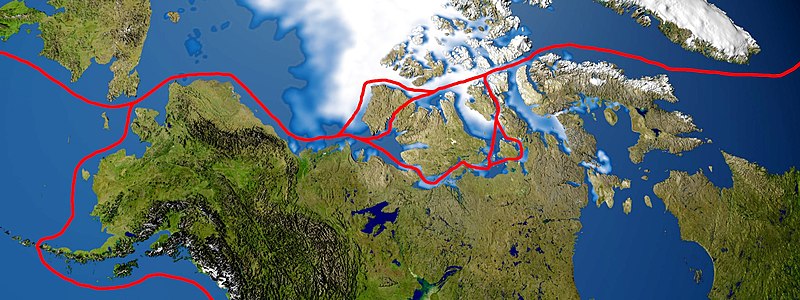 Canada, it seems, stands to see its overall prospects brighten as global temperatures climb. In fact, there are already hints of geopolitical tensions on the rise up in the Artic circle, as a result of changing climate. The Northwest passage, which allows ships to sail from the Pacific to the Atlantic along a northerly route, which is shorter (2,480 miles less) than using the Panama Canal, is staying passable longer because of reduced ice. Canada is increasing its military presence in the area, reports Fox News, to assert its control of this emerging international shipping lane. The U.S., however, asserts it is international waters, and during the Cold War had long sent submarines and navy vessels through the strait .
There is also the promise of untapped oil resources, which is causing friction between northern countries. The AP reports that Russia is working to create a legal case for their claim to millions of square kilometers of territory under the Arctic Ocean. International law says that a country can claim rights to seabed within 200 miles of its continental shelf. And new research is showing that Russia's territory may extend farther beneath the sea than previously thought. In early August, Russia even went so far as to recreate an inner space version of the Moon landing by sending a sub to the bottom of the Arctic to drop a titanium Russian flag, symbolically claiming the territory. The prize is a possible 10 billion tons of oil and gas deposits. GEO


![U.S. Megas [America2050.org]](http://www.america2050.org//sync/elements/america2050map.png)